Fiona Bryson on Kaari Upson
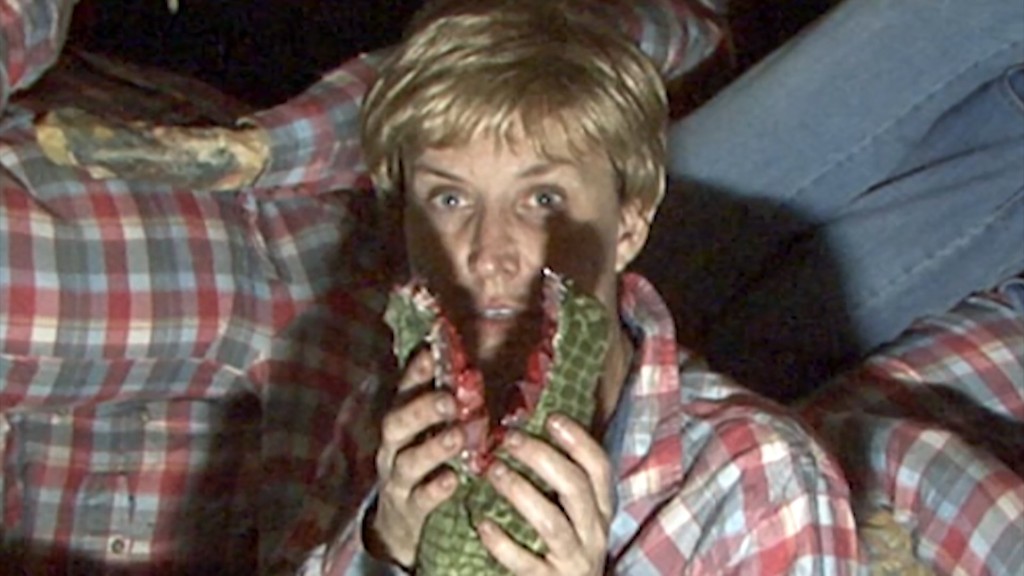
A recurring theme in Kaari Upson’s work was mimicking her mother, Karin. For Recluse Brown (Video, 2015–16), she photographed herself at Costco in a blond wig and the “Upson outfit.” With In Search of the Perfect Double (Video, 2016–17), Kaari expanded on twinning as the Karin look-alike, playing with the idea of the other as a doubling of itself, and filming herself inside over fifty interchangeable tract houses near Las Vegas. In Crocodile Mother (Video, 2016), again wearing the obligatory gingham shirt and jeans, she was this time surrounded by identical-looking “Karin” dolls.
In the film, she recites a phrase of Lacan’s in French and the word Krokodil emerges: German for crocodile—the mother tongue. Her mother had, in fact, immigrated to the United States from Germany. The doubling of the mother figure and the fixation with the maternal crocodile, who “protects its young by carrying them in its mouth,” was explained by writer and critic Leslie Dick, a professor of Kaari’s at CalArts, in a 2022 talk, as the nurturer who can also kill.
The reference is to Lacan’s Seminar XVII: “The role of the mother is the mother’s desire. This is of cardinal importance. The mother’s desire is not something that can be tolerated just like that, that you are indifferent to. It always causes damage. A huge crocodile between whose jaws you are—that is the mother! You never know what may suddenly come over her and make her shut her trap.”
In Crocodile Mother, Kaari looks at the camera, surrounded by the doubles of her mother, and says: “In the origin was the founder with his paternal might. I’m not only with my mother. There exists a father who created me.”
The phallic mother who devours and is all-encompassing: “That is the mother’s desire,” Lacan writes. The origin story is that Karin Ingeborg Upson was born in East Germany at the end of World War II and, after a poverty-stricken childhood, emigrated in her early twenties. Of all places in the United States, she chose San Bernardino and remained there until her death in 2020. Kaari Upson was puzzled by the detached tone her mother used in a personal memoir, recounting war atrocities factually but without emotion. A Post-it in Kaari’s book for her exhibition My Mother Drinks Pepsi! (2014–16) reads: “Find a therapist to ‘translate’ this memoir.”
In Crocodile Mother, Kaari looks at the camera, surrounded by the doubles of her mother, and says: “In the origin was the founder with his paternal might. I’m not only with my mother. There exists a father who created me.”
“Going to Costco. in your truck… Strolling around the Costco. with an oversized shopping cart… Purchasing 1008 Pepsis today.” “One time my mom came by the studio and saw me working on the cans… She saw all the empties… And she said […] ‘I wish someone told me. I would’ve drank them. I drink Pepsi.’” (My Mother Drinks Pepsi! book, 2016)
Jouissance is key here, as it reflects the noise Karin made every afternoon upon opening her first can of Pepsi—a gesture accompanied by an exclamation of pleasure. As the signifier of an excessive, deadly pleasure, jouissance represents unconscious desire that is both orgasmic and possessed of immense tension. For Kaari, this noise was unpleasant, even repulsive.
Whether she decoded her mother’s memoir remains unclear. She did, however, realize that although her mother chose the Mojave Desert, which incorporates Death Valley, to escape the burden of history, it was also to recreate danger, this constant of her past, so inescapable there. One year before Kaari—who passed away in 2021—Karin died and became a preoccupation in the final year of Kaari’s life. Resurfacing over and over in countless paintings and sculptures, Kaari may have asked, “Chez voui?”—“What does she want from me?”
Jacqueline Rose writes of “transgenerational haunting,” the unconscious passage of historical trauma from one generation to the next. Kaari was a mother herself, and the link between desire and the death drive is there in the work: “We bring our ancestors behind us, which means that, while we may die our own death, we also die on behalf of others who were there before us.”